


The group of infectious diseases includes foot fungus, which is a type of mycosis.This pathology is caused by microscopic fungi.A nail disease is called onychomycosis.
Fungal infections of the feet
This is a very common disease among men and women.The most common types of mycosis are:
- trichophytosis;
- candidiasis;
- Athlete's foot.
Some fungi can affect both animals and humans.It is necessary to know not only what mycosis is, but also why it develops.The main mechanism of human infection is contact.It is implemented directly and indirectly.In the first case, the fungi attach to the feet through contact with the soil, plants or a sick person.There are known cases of familial infection.
Indirect transmission of the pathogen occurs through contact with animal care items and patients' personal belongings.This could include shoes, towels and scissors, as well as bathroom accessories.
Often the transmission factors are socks, thigh-highs and other personal items.Foot fungus can develop after visiting public restrooms and swimming pools.The process involves both the skin of the feet and the nails.
The predisposing factors are:
- increased sweating of the feet;
- the presence of calluses and abrasions;
- wear tight shoes;
- lack of personal hygiene;
- wearing someone else's shoes;
- dormitory accommodation;
- weakened immunity;
- poor nutrition;
- the presence of other skin diseases;
- hypovitaminosis;
- alcohol addiction;
- smoking;
- walk barefoot;
- endocrine disorders.

This problem is most often encountered by weakened people.
General clinical manifestations
Fungus on the sole and nails can go unnoticed for a long time.With this disease the following symptoms are observed:
- peeling of the skin;
- dryness;
- presence of diaper rash;
- thickening of the skin and nails;
- brittle nails;
- redness;
- itching;
- white or yellowish coating;
- presence of erosions;
- skin pain.
Fungi on the feet look different.It all depends on the type of pathogen and the underlying disease.Sometimes an unpleasant odor leaves a person.The fungus on the foot does not lead to a deterioration of the general condition.There are no symptoms of intoxication, since fungi are opportunistic microbes and are localized in the superficial layers of the skin.
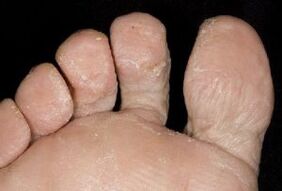
Initially one leg is affected.Then the mushrooms are taken to the second flap.Most often the following areas are involved in the process:
- dorsum of the foot;
- spaces between 4 and 5 fingers;
- nail plates.
Depending on the clinical signs, squamous, dyshidrotic and intertriginous forms of the disease are distinguished.In the first case, scales appear on the red skin.Flaking is observed.Itching is a variable symptom.It does not bother all patients.In the dyshidrotic form of mycosis, bubbles appear on the fornix.They may increase in size.After a few days they open.In their place erosion appears.An area of diaper rash appears.As the erosions dry out, peeling is observed.
If foot skin fungus is complicated by a bacterial infection, the exudate becomes purulent.Pain appears.Possible fever.Fungal infection sometimes causes the development of intertriginous mycosis.Its main characteristic is the presence of cracks with a white edge.Over time, crying develops.Pain appears.Erosion forms in the area of cracks.This form of the disease occurs in a chronic form with exacerbations in summer.
Development of onychomycosis of the legs
Along with fungi, onychomycosis can be found on the feet.With it, the nails are involved in the process.The prevalence of this pathology among the population is 10-20%.In recent years, cases of the disease in children have increased.Fungi actively grow and multiply not only on the skin, but also on the nails.
People with varicose veins, hyperhidrosis, flat feet and endocrine diseases often face a similar problem.Fungi multiply inside the nail, gradually leading to its destruction.If the disease is not treated, it can last for years.The result is detachment of the nail.Hyperkeratosis often develops.
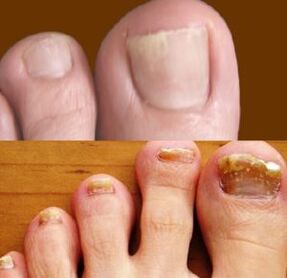
There are hypertrophic, normotrophic and atrophic onychomycosis.In the first case, the nail becomes dull and thickens.With atrophy, the color of the plaque becomes brown.We observe his detachment.With normotrophic onychomycosis, the shape and size of the nail do not change.With the development of onychomycosis on the feet, the following symptoms are observed:
- decrease in nail density;
- changing its color;
- the presence of white or yellow spots;
- itching;
- cracks on the skin;
- peeling;
- plaque thickening;
- greater fragility.
If nail fungus is left untreated, there is a risk of developing paronychia.In this condition, purulent inflammation of the nail bed occurs.
Examination and treatment tactics
You need to know not only how the fungus on the foot starts, but also how to get rid of it.The treatment regimen is determined by the attending physician.Before that, the following studies will be necessary:
- examination using Wood's lamp;
- microscopy of scrapings;
- general clinical tests;
- sowing on a nutrient medium.
The differential diagnosis is made with psoriasis, onychodystrophy, lichen planus, congenital pachyonychia, trauma and eczema.
Every experienced dermatovenerologist knows how to treat toenail fungus.Antifungal drugs are used in the form of solutions, creams and varnishes.
Treatment for foot fungus often involves surgery.The affected nail is removed.
For long-term cases of athlete's foot, a systemic foot fungus treatment of miconazole or ketoconazole may be prescribed.Proper treatment can destroy germs.There are products on the market that facilitate the removal of affected nails.They are available in patch form.
To increase the effectiveness of the treatment of skin fungi on the legs, vitamins, antibiotics (in case of secondary infection) and various ointments based on zinc and salicylic acid are prescribed.
You also need to follow some rules:
- Feet should be washed every day.
- You need to change your socks more often.
- After finishing therapy, old things should be thrown away.
- Socks, tights and stockings should be washed in a separate basin.
- When a fungus is detected on the foot, the treatment will be successful if you wear closed slippers.
At the end of the therapy, a curettage control examination is carried out.